Kwiff Bookmaker in 2026: How Random Supercharge Odds Affect Betting Payouts
Kwiff approaches sports betting differently from bookmakers that offer fixed odds boosts on selected matches. Its defining feature, Supercharge, gives accepted sports bets the chance to receive higher odds without changing the original stake or selection. The increase happens randomly after a bet has been placed, meaning customers cannot predict which wagers will benefit or how large the improvement might be. In 2026, Supercharge remains a central part of Kwiff’s betting experience, covering singles, accumulators, Bet Builders and other supported bet types. However, receiving higher odds does not guarantee a profit, and substantial increases can still be subject to payout limits. Understanding when Supercharge applies, how returns are calculated and what happens when a selection is void is essential for assessing its actual financial value.
How Kwiff Supercharge Works in 2026
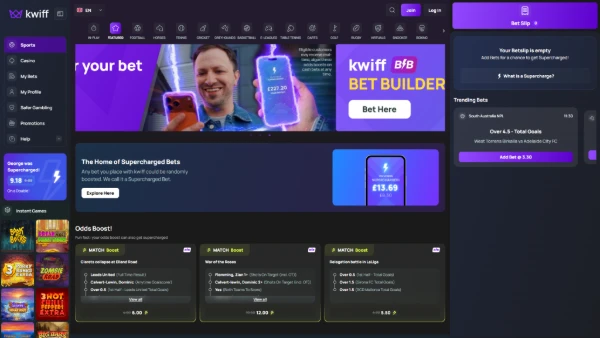
Supercharge is an automatic odds enhancement that Kwiff applies to selected sports bets after accepting them. Unlike conventional bookmaker promotions, which usually advertise a particular event or increased price beforehand, Kwiff determines whether a qualifying wager receives an improvement during the confirmation process. Customers choose their selections, enter a stake and submit the bet at the displayed odds. If the wager is selected for Supercharge, an animation reveals the increased price. The original stake remains unchanged, and the enhanced odds become relevant when calculating the potential return. Kwiff’s official explanation, published in May 2026, confirms that Supercharge can apply to pre-match and in-play betting across different sports and markets.
The important distinction is that a Supercharge is possible rather than guaranteed. Kwiff does not publish a fixed probability of receiving one, nor does it provide a universal percentage increase for every successful selection. Its terms explain that the decision depends on several factors, which may vary between customers, events and different periods. Consequently, receiving an enhancement on one wager does not establish how frequently another customer will receive one. Neither a particular stake size nor a sequence of previously unsuccessful Supercharge attempts provides a reliable method of predicting the next result. The bookmaker’s published rules also make clear that ordinary Supercharge increases concern sports betting rather than casino wagers.
Another notable feature is the range of eligible betting formats. Kwiff’s 2026 guidance includes single bets, traditional accumulators, Bet Builders, Acca+, Bet Builder+, multi bets and certain Flex Bet arrangements. The possibility of Supercharge also extends to in-play wagers, although market availability and bet acceptance still depend on normal betting conditions. For example, a customer might place a £5 football single, a £10 tennis accumulator or a multi-selection football Bet Builder. Each could potentially receive enhanced odds, but none is automatically entitled to an improvement. Individual promotional offers may introduce separate conditions or guaranteed boosts, so customers should distinguish ordinary random Supercharges from promotions requiring an opt-in or a qualifying wager.
What Happens When a Bet Receives a Supercharge?
The process begins with an ordinary bet slip. Suppose a customer selects a football team to win at decimal odds of 2.50 and stakes £10. Before the wager is submitted, the potential total return is £25, including the original £10 stake. Once Kwiff accepts the bet, the Supercharge process may increase the odds. If the price rises to 4.00, the potential total return becomes £40, with £30 representing profit. The customer has not paid an additional £10 or selected a different market. The entire £15 improvement comes from the change in odds. If the selection loses, however, the £10 stake is lost just as it would be on an ordinary bet.
Kwiff uses an on-screen animation to communicate the result. Its 2026 guide describes a short countdown followed, when applicable, by an animation showing the original odds increasing. This presentation serves an informational purpose: it identifies whether the accepted wager has been enhanced and shows the revised price. The animation itself does not influence the sporting event, and a larger visual increase does not make the original prediction more likely to succeed. Customers should verify the confirmed odds and potential return in their betting records rather than relying only on the introductory display. This is particularly relevant when several bets are submitted close together or when live markets are moving rapidly.
Supercharge should not be confused with a free bet, cashback payment or separate bonus balance. The ordinary mechanism increases the odds attached to an accepted wager rather than adding money to the account before settlement. Kwiff’s published conditions also state that winnings from Supercharged bets are not subject to wagering requirements, meaning the resulting winnings do not need to be staked again simply because the odds were enhanced. Nevertheless, standard settlement rules, account verification requirements and applicable maximum payout limits remain relevant. An enhancement improves the possible financial return from a successful prediction; it does not remove the risk of losing the original stake or guarantee that the displayed theoretical return will exceed the bookmaker’s payment limits.
How Supercharge Changes Potential Winnings and Payouts
The financial effect of Supercharge is easiest to understand through decimal odds, which express the total potential return for each unit staked. To calculate an ordinary winning bet, multiply the stake by the accepted decimal odds. The resulting figure includes the original stake, so profit is calculated by subtracting that stake from the total return. A £20 wager at odds of 3.00 therefore produces a £60 total return and £40 profit if it wins. Should Supercharge raise those odds to 4.50, the same wager would produce a £90 total return and £70 profit. These are illustrative calculations rather than advertised Supercharge rates, but they demonstrate precisely how an unchanged stake can produce a different payout.
The relationship between the original and enhanced odds also matters. Consider two separate £10 bets. The first increases from 2.00 to 3.00, raising its potential total return from £20 to £30. The second increases from 10.00 to 15.00, raising its potential return from £100 to £150. Both examples involve a 50% increase in decimal odds, yet the second produces an additional £50 rather than £10 because the original potential return was larger. This distinction helps explain why Supercharge results should be evaluated using both the revised odds and the actual amount at risk. A dramatic-looking enhancement on a small stake may have a modest monetary effect, whereas a smaller proportional change on a substantial potential return may represent more money.
Supercharge can also affect accumulators, where multiple selections must normally win for the entire bet to succeed. Imagine a £5 football accumulator containing three selections at decimal odds of 1.50, 1.80 and 2.00. Multiplying those prices gives combined odds of 5.40 and a potential total return of £27. If Kwiff enhances the accumulator’s final odds to 8.00, the potential return rises to £40. The additional £13 is meaningful, but every required selection must still produce the correct result under the bet’s settlement rules. Higher combined odds do not compensate for an unsuccessful leg. Furthermore, any Supercharge applied to an accumulator should be understood through the confirmed overall price, not by assuming that each individual selection receives the same percentage increase.
Payout Limits, Voided Selections and Cash Out
One of the most important restrictions concerns maximum winnings. Kwiff’s published betting rules specify an overall maximum of £250,000 or €250,000 per customer per day, with the day defined as 00:00 to 23:59 GMT. The rules also establish lower event-specific limits for certain sports and competitions. For instance, some football markets have maximum payouts of £50,000, £25,000 or £10,000, while football Bet Builder and multi-match markets are subject to a £100,000 ceiling or the relevant league limit, whichever is lower. These restrictions mean that a Supercharged bet showing a very large theoretical return may not produce an unrestricted payment. Customers should check the applicable market limits before treating a displayed potential payout as an amount they could necessarily collect.
Voided selections introduce another complication. Under Kwiff’s betting rules, an accumulator containing a void selection generally continues with the remaining valid legs. If the original accumulator had been Supercharged, the bookmaker states that the recalculated combined odds of the remaining selections receive a new Supercharge, with its size determined at Kwiff’s discretion. The original boosted price therefore cannot simply be carried over unchanged. For example, if a three-leg accumulator loses one selection because the event is abandoned and the selection is voided, its final calculation will depend on the two remaining selections and any revised enhancement. A completely voided bet ordinarily follows the relevant void-bet settlement rules rather than paying the initially displayed Supercharged return.
Cash Out is another area where customers should distinguish potential returns from money actually received. Kwiff’s May 2026 guide confirms that Cash Out offers can themselves receive a Supercharge, including on bets that were not previously enhanced. For example, a bet with an available early-settlement offer of £18 might receive an enhanced Cash Out offer of £23. If accepted successfully, that payment settles the wager early, removing the possibility of subsequently collecting its full winning return. These figures are illustrative, and Cash Out availability is not guaranteed. The amount offered may change as the event develops, while requests can be rejected if the market moves or the offer becomes unavailable before acceptance. A Supercharged Cash Out should therefore be assessed as a separate settlement decision rather than an additional payment on top of the original bet.
Is Kwiff Supercharge Financially Beneficial for Bettors?
Supercharge offers an identifiable advantage when two otherwise identical winning bets are compared: a higher accepted price produces a larger return, provided the applicable payout limits do not prevent payment of the calculated amount. The feature becomes less straightforward when evaluating betting over a longer period. Since Kwiff does not disclose a fixed Supercharge frequency or an independently verified average increase, customers cannot reliably calculate how much additional value they should expect across hundreds of wagers. A few unusually large enhancements may be memorable without representing typical results. Likewise, a run of ordinary bets without an increase does not establish that another wager is more likely to receive one. The available information supports assessing each confirmed enhancement individually, not assuming a predictable long-term financial benefit.
Comparing Kwiff with another bookmaker also requires attention to the original odds. Suppose Kwiff offers 2.10 on a football outcome while another bookmaker offers 2.25. A £10 winning bet would ordinarily return £21 at Kwiff compared with £22.50 at the alternative bookmaker. If Kwiff subsequently Supercharges the selection to 2.80, its potential return increases to £28 and becomes higher than the competing offer. Without that enhancement, however, the other bookmaker’s quoted price would have provided the greater return. The practical lesson is that an uncertain future boost should not be treated as part of the price available before placing a wager. Comparing initial odds remains important, particularly because not every accepted bet will receive Supercharge.
Betting strategy should also account for the difference between a higher payout and a higher probability of winning. Odds express a bookmaker’s price for an outcome, and their implied probability can be estimated by dividing 100 by the decimal odds. A price of 2.00 corresponds to an implied probability of 50%, while 4.00 corresponds to 25%. These figures are mathematical interpretations of betting prices, not verified forecasts of sporting results, and they do not remove the bookmaker’s margin. If Supercharge increases an accepted price from 2.00 to 4.00, the likelihood of the football team, tennis player or other selection actually winning remains unchanged. Only the payment available if the prediction succeeds has improved. This separation between probability and potential return is central to understanding the feature.
Practical Considerations Before Placing Supercharged Bets
A sensible way to evaluate Supercharge is to examine the original odds, selected market and stake before confirming the wager. Those details determine the financial commitment even when no enhancement is awarded. Customers can then check the revised odds in their betting history whenever a Supercharge occurs and calculate the difference between the original and enhanced potential returns. For accumulators and Bet Builders, it is also important to understand how individual selections interact and what happens if a leg is voided. Kwiff’s rules confirm that an accepted bet is recorded with a unique bet ID, while the betting history provides details of accepted wagers. Keeping track of these records is more reliable than judging the feature by isolated examples of exceptionally high payouts.
Special promotions deserve separate attention because they may operate differently from ordinary random Supercharge. Kwiff’s 2026 guide describes a weekend promotion offering a guaranteed Supercharge on an eligible accumulator after the customer opts in. The published example requires at least three selections, minimum odds of 1.50 per selection and a stake between £1 and £100, with wagers placed during the specified weekend period. Such conditions should not be interpreted as restrictions on every ordinary Supercharge, since the underlying random feature has different eligibility arrangements. Equally, a promotional guarantee should not be assumed to apply outside the advertised offer. Before participating, customers should check the current promotion, eligibility criteria, qualifying odds and expiry period rather than relying on conditions that may have changed.
Risk management remains relevant even when the potential return is unexpectedly increased. Setting a spending limit before betting helps prevent a temporary enhancement from influencing the amount committed to later wagers. A £10 bet that receives a substantial Supercharge may produce an attractive potential return, but it remains possible to lose the entire £10. Increasing subsequent stakes to reproduce an earlier enhancement does not change the unpredictable nature of the feature. Customers should also consider account and market restrictions, including verification checks and withdrawal requirements. In Great Britain, gambling services are restricted to adults aged 18 or over, and support is available through organisations such as GamCare and the National Gambling Helpline. Ultimately, Kwiff Supercharge changes how much a successful wager can pay, not the underlying sporting result or the financial risks associated with betting.